The house becomes a dangerous trap
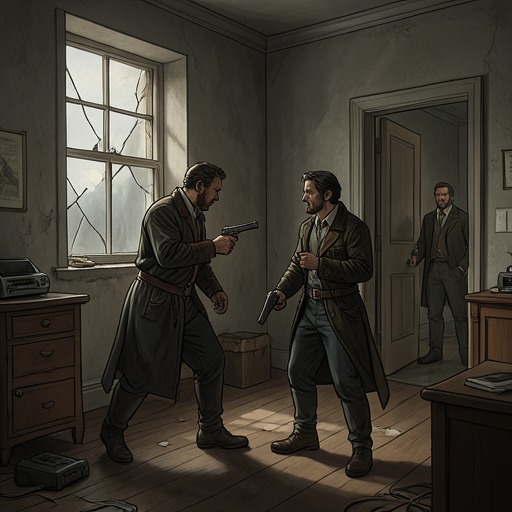
The War of the RosesThe house becomes a dangerous trap when Oliver Rose and Barbara Rose transform their shared home from the expression of a life they built together into a weapon in their fight over separation. Their struggle is at once financial, legal, and physical: the question of who may remain in the house becomes a reason to stay, while the home’s familiar rooms, appliances, stairs, and possessions are progressively made unsafe. The change is especially bitter because the house had been a joint undertaking, not merely a valuable property. Its domestic details become instruments of a conflict neither spouse can readily leave behind.
A Shared Home Becomes Contested Property
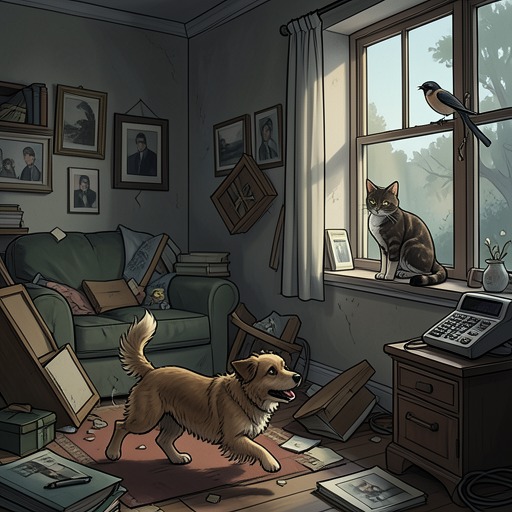
The danger grows out of a home that had once embodied the Roses’ cooperation. The house exceeded their expectations; pleased by its appearance, they commissioned a copperplate engraving of it to send at Christmas. The narration makes their identification with it explicit: the house was them. Their antiques, gathered together on weekends at auctions and old Virginia and Maryland homesteads and during European vacations, accumulated memories of their married life as well as material value. When Oliver consulted Murray Goldstein about the divorce, he described the house and everything in it as the joint property into which the couple had put everything. He estimated that the house might sell for at least half a million dollars, with the antiques worth another half-million or more, and remembered how much love they had lavished on the place.
The house also contained the work of Barbara’s developing ambitions. Interested in cooking from childhood and experienced from summer work with professional cooks and bakers, she began considering a business as the children demanded less of her time. She had the kitchen designed with commercial use in mind. Oliver supported the project vigorously, devoting weekends to its construction and applying his knowledge of electrical circuitry and craftsmanship; Barbara learned practical repairs and helped him build the sauna and adjoining shower. The kitchen’s later hazards therefore turn a shared construction project into a particularly intimate site of danger.
The couple’s opposing ideas of a fair settlement sharpened the contest. Oliver initially told Goldstein that half the value of the house and possessions would be acceptable. Harry Thurmont explained to Barbara that this meant a market valuation and a cash settlement, not that she would keep the house and its contents. Barbara objected that she had spent nearly twenty years supporting Oliver’s career and needs, given up schooling, raised their children, and devoted more time to the house than Oliver had. She could not match his earning power and feared he could eventually replace the house’s value while she would be left with cash. To her, the house represented a way of life as well as an asset, and she insisted that she wanted to keep all of it.
Law and Domestic Boundaries
The law did not immediately resolve who could occupy the home; instead, it shaped the conditions under which the Roses continued living there. Goldstein explained that a no-fault divorce in the District of Columbia required a six-month waiting period if uncontested and a year if contested, while a property settlement could continue separately, potentially through a court decision. Later, he pointed Oliver to Title 16-904, Section C, which allowed spouses to obtain a no-fault divorce while living under one roof, provided they lived separately. Oliver therefore did not have to move out. Goldstein cautioned that the court could still order the house and its contents sold, but Oliver hoped that remaining in place would demonstrate his determination and perhaps force Barbara to leave.
That legal arrangement made the house a shared address without restoring it as a shared home. Their separation agreement required Barbara to keep her catering expenses separate from household money. When delayed payments from customers and demands from suppliers left her short, she borrowed from household funds; Thurmont rebuked her, and Oliver obtained an injunction requiring her to keep the business expenses separate. In another dispute, Barbara went to court and secured an injunction forbidding Oliver from breaking into her room. The ruling gave a formal boundary to a conflict already taking place inside their home, but it also unsettled Josh, who asked whether Oliver would go to jail if he violated it. Legal remedies thus entered the household as practical constraints and sources of further anxiety, rather than ending the conflict.
The House Is Turned Against Its Occupants
The physical escalation first erupts in the kitchen as Barbara prepares to cater a dinner party. Determined to prove she could provide a complete service, she moved a cot into the kitchen so she could prepare the food the day before and work through the night. She inspected the ingredients and wine for tampering. Then the kitchen’s ordinary equipment began to fail in dangerous succession. Cold water would not run from the taps; when she tried the hot setting, scalding water burned her hand. A mixing head flew off and narrowly missed her. The Cuisinart kept running after she switched it off, and its plug would not come free. The stove burners glowed red despite her attempts to turn them down. When she pulled at the machine’s wire, it fell and sent its slicer blade ricocheting across the kitchen.
The danger became an assault by the room itself. Barbara fell to avoid being struck, and the knife box toppled, scattering blades that cut her thighs. She burned her hand again at the faucet; as she recoiled, she activated the disposal, which would not stop. The range-hood fan and blenders started, followed by the toaster, coffee maker, microwave, and dishwasher. The appliances seemed to come on one after another, turning her prepared workspace into a chaotic array of hazards. The episode showed how a domestic environment could be made threatening without ceasing to look like a kitchen: its tools and conveniences remained recognizable, but no longer reliable.
Retaliation spread beyond the kitchen into the private rooms and work spaces. After returning to the house, Barbara found a note on her door indicating that Oliver’s turn had come. Inside, the smell confirmed her suspicion that he had made another key and had tampered with her Valium. He had opened the canned goods she had stored in her room and emptied them into the sink, bathtub, and toilet, where the food was beginning to rot. He had also cemented the window casements shut. When Barbara tried to fill the bathtub with water, she discovered that he had blocked the drain.
Barbara responded by equipping herself for life inside the hostile house. In a canvas shopping bag she collected a flashlight, candles, matches, bread, cheese, and cookies, then took the heaviest sharp cleaver she could find. She entered Oliver’s workroom, took a hammer and screwdriver, emptied his carefully organized containers of screws, bolts, nails, and other small hardware, cut the wires on his power tools, and submerged other tools in lubricating oil. The act deliberately attacked the order of his personal workshop, which she had long disliked. In the Roses’ increasingly literal domestic war, even storage, maintenance, and organization became ways of asserting control.
Oliver, in turn, made the house’s routes dangerous. After finding the library armoire overturned and the room smelling of liquor, he went toward his workroom and fell on metal objects scattered across the stairs, injuring himself. He later used a crowbar to pull the carpet runner from the staircase, sprayed the exposed steps with silicone, and poured oil over the remaining boards. He also wedged a door shut. These measures were not simply symbolic: they changed how a person could move through the house, turning stairs and thresholds into hazards for anyone who did not know what had been altered.
A Familiar Interior Becomes an Unreadable Maze
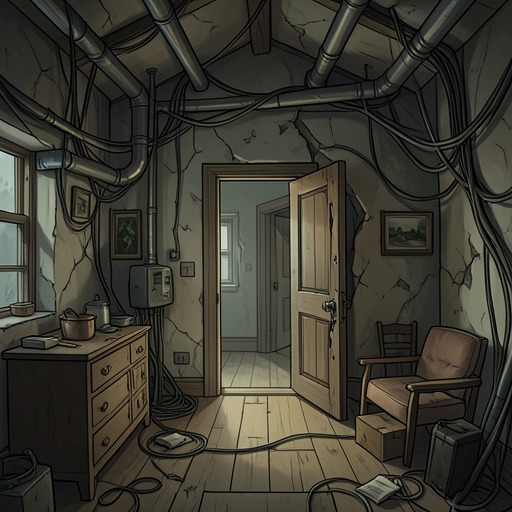
The house’s danger depended on its familiarity being broken. When Barbara later entered through the sunroom and moved into the kitchen in darkness, she found the room’s arrangement altered. A rope triggered falling pots; the kitchen no longer corresponded to her memory of where things belonged. On the marbled foyer floor she lost her footing and slid, unable to rise because the surfaces she reached were too slippery to hold. The refrigerator began to tip toward her, and she barely jumped aside. At the basement door she found that the steps were gone; she saved herself by locking her arms around the banister, bracing her legs against the walls, and lowering herself until she reached the floor. What had once been a navigable family home now demanded bodily vigilance at every turn.
The contest continued as a cycle of prediction and countermeasure. Oliver ate stale bread and drank wine before discovering a broken Staffordshire figure and a message from Barbara threatening to break another each day. He removed hinge bolts so that doors would fall at the slightest movement, loosened furniture supports, and weakened the fastenings of kitchen shelves, cabinet doors, and overhead pot racks. Meanwhile Barbara listened from the attic, mapping his progress by sound as he worked. She believed the house was her ally and that his devices could not truly hurt her; her confidence rested on knowing its spaces and on her resolve to outlast him. But that knowledge was itself under attack, because Oliver kept changing the conditions she had learned to trust.
The house’s transformation is therefore both material and interpretive. Objects that once registered shared taste, practical skill, or domestic routine become means of exclusion and injury: the kitchen appliances, the workshop tools, the doors, the stairs, the furniture, and even prized antiques. A home built and furnished through the couple’s collaboration becomes the setting where each tries to make the other yield. Its danger comes not from unfamiliar territory but from the corruption of the familiar: the rooms remain theirs, yet ordinary movement through them can no longer be assumed safe.